ITS Sandbox 1

Mason community welcome to aid in development of new Climate Action Plan

Mason community welcome to aid in development of new Climate Action Plan
John Hollis
Mon, 11/22/2021 – 14:21

Body
Photo by Getty Images

More than 100 members of the George Mason University community tuned in for last week’s initial Climate Action Plan Town Hall, and every incoming suggestion is on the table as the university considers how to best move forward in the fight against global warming.

The virtual panel discussion, which featured Mason’s Greg FarleyLeah Nichols and Dann Sklarew, was the first of five opportunities in which Mason students, faculty, staff and community members could make their voices heard in the formation of a new Climate Action Plan. The next town hall will be held Dec. 15, and three more will be held in early 2022 on Jan. 27, Feb. 18 and March 9. Learn more and register here

Greg Janks of consulting firm Dumont Janks, which helped develop Mason’s new master plan, served as the event’s host. 

“As we sail around the sun on Spaceship Earth, we need to be conscious of the many ways that our activity impacts the spaceship that we’re flying on,” said Farley, the director of Mason’s University Sustainability. “We can make a difference.” 

Mason hopes to significantly reduce its greenhouse gas impact and achieve carbon neutrality by 2040, but there’s still much work to be done. The university’s overall carbon footprint has remained steady in recent years at roughly 104,000 metric tons, Farley said. 

The panel noted that nearby American University achieved a net zero carbon footprint status in 2018 in part by building a solar farm in North Carolina to help provide the university with clean energy. 

“All options are on the table,” Farley said. 

Nichols, who is the executive director of Mason’s Institute for a Sustainable Earth, called on all Mason faculty, students, staff and the entire community to participate in the process so as to bring the community’s collective research and programming together in hopes of creating “a more just, prosperous and sustainable world.” 

“Tackling climate change takes a village, it takes everyone,” Nichols said.

The town hall was Mason’s first step in the development of a new Climate Action Plan. The first was developed in 2010, but needs revision and updating in the wake of more scientific advances in the past decade. 

Farley opened the conversation by noting a recent study that concluded sub-national level climate planning—mostly city climate planning—helped account for a 6% decrease in U.S. greenhouse gas emissions in 2018. The Mason community, he said, could potentially have a similar impact with its more than 50,000 members. 

“If we constrain our carbon emissions and our contributions to global warming, we can help be a part of that 6% and drag that upwards,” Farley said. “That is the level in which action really needs to take place.” 

The new Climate Action Plan will be developed in two phases. Phase 1 will develop the university’s broad strategy for seeking carbon neutrality. The plan will probably not affect leased spaces, such as Mason Korea and the Loudoun County facility, Farley said. 

Mason President Gregory Washington has asked for the initial phase to be completed by April 7, 2022, Mason’s 50th anniversary, and focus on electricity use and the fossil fuels used on all Mason campuses. This phase will also help set priorities and identify the most effective steps that the institution can take to reduce its greenhouse gas impact as quickly as feasible.

Phase 2, which will begin in April 2022, will examine emissions from travel and commuting, purchasing, food, and other sources.
Peter Stearns receives American Historical Association recognition for a lifetime of distinguished scholarship

Peter Stearns receives American Historical Association recognition for a lifetime of distinguished scholarship
Colleen Rich
Thu, 11/18/2021 – 14:26

In This Story

People Mentioned in This Story

Body
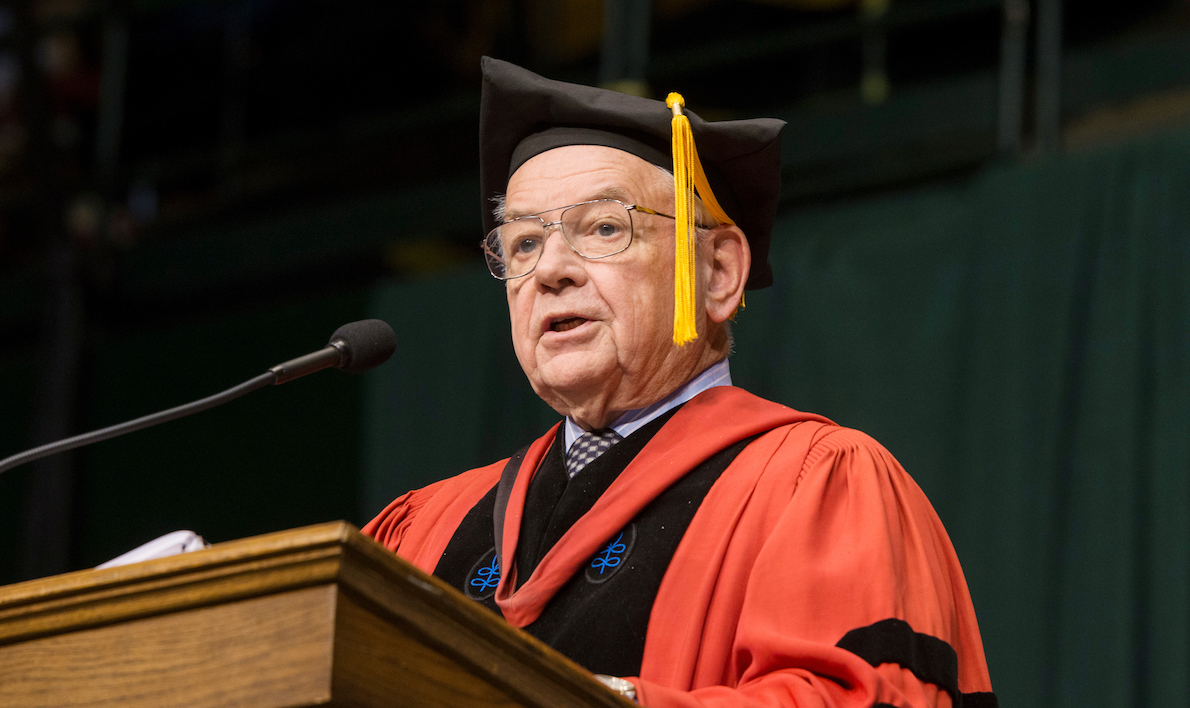
Peter Stearns at Commencement 2013. Photo by Creative Services

Peter Stearns, University Professor of History and provost emeritus at George Mason University, thinks there is more to know about happiness. So he is currently at work on a book that collects a variety of perspectives on the subject.

With two colleagues, he is organizing essays that represent diverse takes on happiness.

“Happiness is obviously an important current topic globally, but the historical research is scattered,” said Stearns, whose book “Happiness in World History was published this year. “It’s an opportunity to collect a wider range of essays to try to establish different regional perspectives on happiness over time.”

The book will be the latest in a long line of Stearns’s impressive output of scholarship over his 58-year career; he has written, edited, or developed new editions of more than 150 volumes.

In addition to his research and writing, Stearns served as Mason’s provost from 2000 to 2014, when the university more than tripled its level of funded research and number of doctoral programs. While provost, Stearns also launched Mason Korea in Songdo, South Korea, and the collaboration with INTO to increase the number and diversity of students recruited from abroad. These projects, deeply rooted in a desire to increase global understanding, have fostered opportunities for constructive collaboration among different societies.

He also remains active in the classroom, teaching a course each fall and spring. Mason’s Stearns Center for Teaching and Learning, launched in 2017 and an integral part of Mason’s rapid pivot to online teaching in March 2020, bears his name as a nod to his role as provost, his work in creating Mason’s Center for Teaching Excellence, and in the words of then-provost David Wu, his “tireless advoca[cy] for excellence in teaching.”

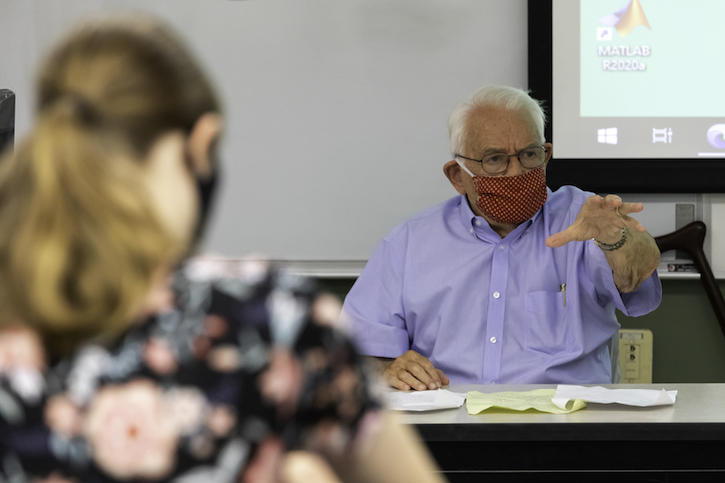
University Professor Peter Stearns teaching an Honors College class in fall 2020. Photo by Lathan Goumas/Strategic Communications

Prior to his time at Mason, he taught at Harvard University, the University of Chicago, Rutgers University, and Carnegie Mellon University, also serving in the administration at Rutgers and Carnegie Mellon. It was at Chicago that he founded the Journal of Social History, which is now edited at Mason.

With these contributions to the fields of history and education, and his extensive work with other journals and professional organizations, Stearns has earned a host of awards, the latest of which is the American Historical Association Award for Scholarly Distinction to his list of accolades.

Established in 1984, the award recognizes “senior historians of the highest distinction who have spent the bulk of their professional careers in the United States,” according to the AHA website. A full citation of the prize will be printed in the December issue of the AHA ‘s newsmagazine, Perspectives on History, and an awards ceremony will be held in January 2022, during the AHA’s annual meeting in New Orleans.

“The impact that Peter has made through his teaching, his leadership, and of course his scholarship, is extraordinary,” said Ann Ardis, dean of Mason’s College of Humanities and Social Sciences. “Peter’s students and faculty colleagues at Mason are fortunate to have benefited from all three elements of his career accomplishments.”

Stearns is the second Mason faculty member to earn this honor from the AHA, said Matthew Karush, chair of the Department of History and Art History. Lawrence Levine, who taught at Mason from 1994 to 2005 after retiring from a 30-year career at University of California, Berkeley, also received the award.

“The list of previous winners includes some of the absolute giants in the field,” he added. “These really are the most prominent and influential historians of their time.”

Stearns particularly appreciates the award in light of the variety of work that his career represents.

“I’ve had a good bit of time in administration as well as teaching,” he noted. “But I’ve always been committed to historical scholarship and particularly the exploration of new subjects for historical analysis—like happiness. I’m certainly grateful for the honor given the diversity of my own career.”

Mason community invited to join Climate Action Plan Town Hall to be held on Friday

Mason community invited to join Climate Action Plan Town Hall to be held on Friday
John Hollis
Wed, 11/17/2021 – 14:47

Body

The entire George Mason University community is invited to participate in Friday’s Climate Action Plan Town Hall and have a say in how the university moves forward in the fight against global warming. 

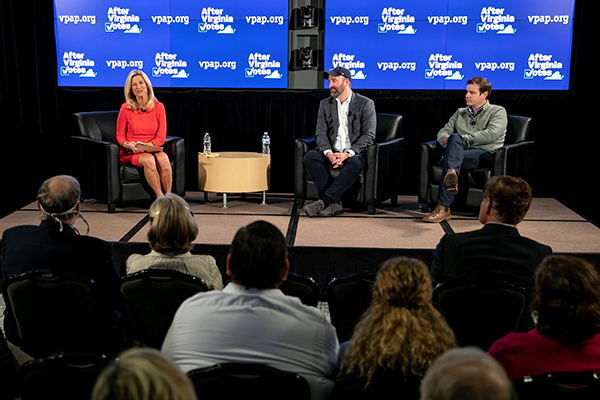
The panel discussion, which will feature Mason’s Greg FarleyLeah Nichols and Dann Sklarew, will be held virtually on Zoom starting at 1:30 p.m. The hour-long event will mark the first of five opportunities in which Mason students, faculty, staff and community members can make their voices heard. 

Greg Janks of consulting firm Dumont Janks, which helped develop Mason’s new master plan, will host the event. Go here to watch and participate online. 

“What we want to do is plan for climate neutrality for the university,” said Farley, the director of Mason’s University Sustainability. “So we want to see the widest variety of people and get the widest variety of perspectives.” 

The town hall is among the first steps Mason is taking to develop a new Climate Action Plan for the institution. Sklarew, a professor in the Department of Environmental Science and Policy within the College of Science and Mason alum, helped develop the university’s first Climate Action Plan in 2010, which needs revision and updating.  

The new plan will align with advances in scientific understanding of climate change over the past decade and will affect the entire university, Farley said. “It will set forth a plan for climate neutrality that is both ambitious and achievable.” 

The new Climate Action Plan will be developed in two phases. Phase 1 will develop the university’s broad strategy for seeking carbon neutrality. The plan will probably not affect leased spaces, like Mason Korea and the Loudoun County facility, Farley said. 

Mason President Gregory Washington has asked for the initial phase to be completed by April 7, 2022, Mason’s 50th anniversary, and focus on electricity use and the fossil fuels used on all Mason campuses. This phase will also help set priorities and identify the most effective steps that the institution can take to reduce its greenhouse gas impact as quickly as feasible.  

Phase 2, which will begin in April 2022, will examine emissions from travel and commuting, purchasing, food, and other sources.
Sklarew credited Mason students for being “a driving force in advocating for and drafting student inputs into our university climate action plans.”

“We want to bring students and faculty and the entire community into this,” said Nichols, the executive director for Mason’s Institute for a Sustainable Earth, “so that we can find that sweet spot across the board. We’re all working together to make this happen.”   

Climate Action Plan development is a partnership between Mason Facilities and the Mason Sustainability Council’s Carbon Neutrality Task Force. The task force, which includes members from all three of Mason’s principal campuses, including faculty, staff, students, alumni, and administrators, meets monthly and acts as a steering committee for the work of Dumont Janks and Arup, a global engineering consultancy helping with planning and detailed analysis. Mason Facilities has provided funding to retain the consultants.  

The Mason Sustainability Council is a group of academic and operational leaders from across the university tasked with developing and directing sustainability strategy, planning, and action, and identifying opportunities that benefit research, curricular, and operational sustainability. 

Amazon donates $25,000 to M-VETS capital campaign to expand pro bono legal services

Amazon donates $25,000 to M-VETS capital campaign to expand pro bono legal services
John Hollis
Mon, 11/15/2021 – 11:06

Body

With its arrival in Arlington, Amazon has established itself as a significant community partner and continued to strengthen those ties this month by making a donation to the Mason Veterans and Servicemembers Legal Clinic (“M-VETS”) at the George Mason University Antonin Scalia Law School.  The funding will help support a third attorney position, greatly expanding M-VETS’ ability to provide legal support to the local veteran community.  

In an effort to assist a greater number of veterans and to expand its scope of services, M-VETS has partnered with American Legion Post 139 to provide free legal services in the newly renovated Post headquarters housed in the Lucille and Bruce Terwilliger Place, an affordable housing complex spearheaded by the Arlington Partnership for Affordable Housing set to open in 2022.  Not only will Terwilliger Place be home to the new Post 139 headquarters, but, of the 160 units of affordable housing, 50% will have a veterans preference, providing critical housing and resources to local veterans.    

In order to staff the new M-VETS outpost co-located in the American Legion’s new headquarters, M-VETS is leading a capital campaign to hire a third staff attorney dedicated to providing walk-in legal services, direct representation in new practice areas, and supervision of law students in these matters.  Amazon’s contribution will be earmarked to fund the third attorney position.  With the addition of a third attorney and expansion of practice areas, M-VETS anticipates that it will be able to increase its output of pro bono services by nearly 40 percent.   

“With Amazon’s generosity, we have taken a significant step in continuing our mission to fund the third staff attorney position,” M-VETS Director Timothy MacArthur said.  “We are extremely grateful to Amazon for its support of our clinic operations and look forward to continuing our partnership with our new Arlington neighbor.”   

MacArthur emphasized the importance of being able to expand practice areas and provide walk-in legal services at the American Legion Post 139 Headquarters.  “Expanding into the areas of criminal law and employment matters will enable us to assist a greater number of veterans and service members in the community,” MacArthur said.  “In addition, our ability to offer walk-in legal counseling will provide an immediate impact the local military community.”   

M-VETS provides free legal representation to veterans, active-duty service members, and their families while allowing law students to gain practical legal experience under the supervision of practicing attorneys. M-VETS provides representation in a variety of matters including Virginia civil litigation matters, uncontested divorces, consumer protection matters, wills and powers of attorney, as well as assisting with matters before the VA and various administrative boards, including discharge upgrades, record corrections, military pay and entitlement matters, and VA disability benefit appeals.

Political Hindsight: Leaders of Youngkin, McAuliffe Campaigns Take the Stage at Mason

Political Hindsight: Leaders of Youngkin, McAuliffe Campaigns Take the Stage at Mason
Andrew J Schappert
Wed, 11/10/2021 – 14:43

In This Story

People Mentioned in This Story

Body
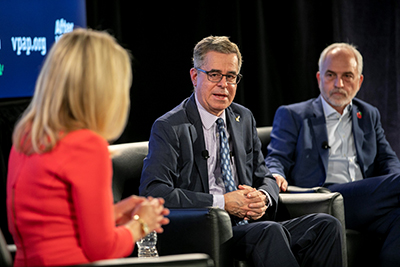
Three people on a stage in front of a blue sign.
Julie Carey, left, moderates the ‘After Virginia Votes’ panel, featuring Will Ritter, center, and Michael Halle. Photos by Shelby Burgess/Creative Services
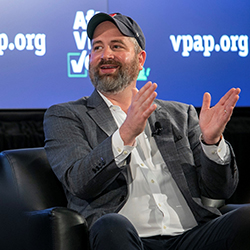
A guy in a Red Sox hat looks happy.
Will Ritter: Youngkin’s campaign did not ‘jump on a gaffe’ by McAuliffe.

Republican gubernatorial candidate Glenn Youngkin’s successful campaign was “a slow march up” while Democratic opponent Terry McAuliffe’s was “a slow march down,” compounded by a miscalculation on issues that resonated with Virginia’s voters, said Will Ritter, Youngkin’s media strategist, during a public post-election examination called “After Virginia Votes.”

Ritter shared the stage at George Mason University’s Merten Hall Tuesday night with Michael Halle, senior advisor to McAuliffe, during the event, a production of the Richmond-based, nonpartisan Virginia Public Access Project (VPAP) and hosted by Mason’s Schar School of Policy and Government.

More than 1,000 viewers tuned in via live streams on GMU-TV, Facebook, and YouTube while 50 invited guests listened to the discussion in person, in accordance with Mason’s pandemic protocols. Cox Communications, one of the event’s sponsors, will re-broadcast the 90-minute event in select markets this week.

Flawlessly moderated by NBC4 Northern Virginia Bureau Chief Julie Carey, the conversation between the upbeat Ritter and the understandably glum Halle provided insights to key moments in the bellwether, $100-million election that led to political newcomer Youngkin’s defeat of McAuliffe, who was running for a second term as governor, by 63,503 votes.

The conversation was followed by a second panel that included veteran Virginia political analysts Quentin Kidd, director of the Wason Center for Civic Leadership at Christopher Newport University, and Mark J. Rozell, dean of the Schar School.

Among other topics, Carey asked how national issues affected the state election, including the pandemic, the election of Joe Biden as president, the teaching of “critical race theory,” the January 6 insurrection, and the withdraw from Afghanistan. For his part, Youngkin, Ritter said, was adamant about keeping the issues local while McAuliffe’s camp continually attempted to attach Youngkin to Donald Trump and the extremist wing of the Republican Party.

Three people discuss politics on a stage.
Schar School Dean Mark J. Rozell makes a point during a discussion with Julie Carey, left, and Christopher Newport University’s Quentin Kidd.

In particular, the local issue of education became a lightning rod following a heated September 28 debate in Alexandria, partially sponsored by the Schar School, in which McAuliffe suggested, “I don’t think parents should be telling schools what they should teach.” Until then, a Washington Post/Schar School poll showed McAuliffe with a slight lead, 50 percent to 47 percent.

Ritter said his campaign did not “jump on a gaffe” but the line crystalized the direction to domestic issues. “We had a choice to make and we chose to run on Virginia issues,” he said. “We predicted McAuliffe would ‘nationalize’ the race, we anticipated the celebrity endorsements, but we decided to stick with Virginia issues.”

In the end, Ritter said, “We had a secret weapon. We had Glenn.”

Kidd and Rozell, both of whom had been writing about and commenting on the election in the press for months, provided additional insight regarding what Youngkin’s election might mean to the Commonwealth.

“As a new governor, you want some early wins” in the state house, Kidd said, suggesting Youngkin is likely to focus on what Rozell called “kitchen table issues, bread and butter issues,” such as his promise to eliminate sales tax on groceries, lower the gas tax, and raise teacher salaries.

State appointments made by the new governor, Rozell said, might be designed to “appease Trump supporters.”

Youngkin will be sworn in as 74th governor on January 15, 2022.

Allison Redlich sees the recognition of her efforts rolling in

Allison Redlich sees the recognition of her efforts rolling in
John Hollis
Mon, 11/08/2021 – 14:09

Body
Professor Allison Redlich. Photo by Ron Aira/Creative Services

George Mason University’s Allison Redlich is being recognized by her peers for her scientific achievements as well as her mentoring efforts.

Redlich, a professor in the Department of Criminology, Law and Society within the College of Humanities and Social Sciences, found out last week that she had been elected a Fellow of the American Psychological Association (APA). The honor follows on the heels of word that she’s also going to be honored with the 2021 American Society of Criminology Mentor Award at the society’s upcoming national conference in Chicago. 

“It feels wonderful,” Redlich said, “especially the mentoring one. I myself have benefitted so much from exemplary mentoring that it’s really important to me to pass it forward. So that one was especially nice to receive.” 

James J. Willis, a professor and the chair of the Department of Criminology, Law and Society, called Redlich one of the department’s most outstanding faculty members. 

“In the same month, to receive national recognition for her scientific contributions to psychology and law, and for mentoring future scholars, is quite remarkable,” Willis said of Redlich. “The fact that she manages to perform at such a high level while also serving as the department’s associate chair and director of graduate programs makes these achievements even more noteworthy. She is an invaluable asset to George Mason University and her accomplishments elevate us all.” 

Established in 1995, the Mentor Award is designed to recognize excellence in mentorship in the discipline of criminology and criminal justice. Redlich is the second Mason professor to be honored with the award, after David Weisburd received it in 2016. 

Robert J. Norris, an assistant professor within the Department of Criminology, Law and Society, credited Redlich for much of his own success. 

“I would not have been nearly as successful if it were not for her,” he said. “She essentially taught me what it means to be a researcher and scholar.” 

Fellowship status is bestowed upon APA members who have shown evidence of “unusual and outstanding” contributions or performances in the field of psychology, according to the organization’s website. Fellow status requires that a person’s work have a national impact on the field of psychology beyond a local, state or regional level.

Mason hosts 17 Rooms-U Summit to discuss, finalize community sustainability goals

Mason hosts 17 Rooms-U Summit to discuss, finalize community sustainability goals
Colleen Rich
Mon, 11/08/2021 – 09:57

In This Story

People Mentioned in This Story

Body

Kirin Emlet Furst, assistant professor of environmental engineering, is part of a group that’s focused on how George Mason University and its partners can contribute to domestic and international efforts to increase access to clean water and sanitation.

Conflict analysis and resolution major Alejandra M Rivera has been working with another group on reducing inequalities. She’s helping create a mentorship program for Mason students to help high school students better understand college and university resources, including scholarships.

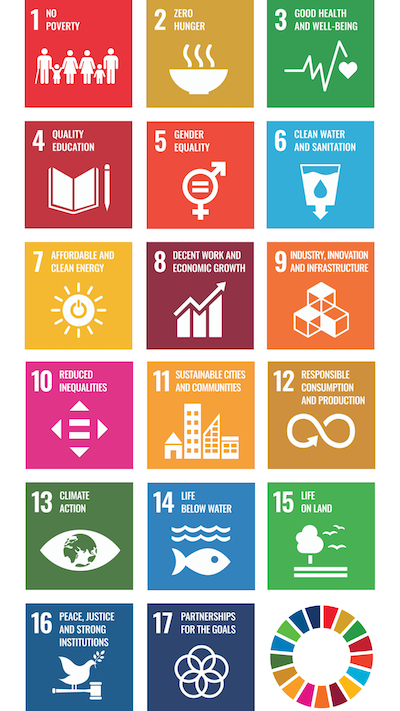
Each “room” at the summit represented one of the 17 goals identified by the United Nations as global topics that need to be addressed, including food insecurity, gender equality and responsible consumption.

They’re two of the more than 180 people who participated in the 17 Rooms-U Summit in early October to discuss their projects and learn about the work being done in other groups to address issues of sustainability on a local level.

Mason’s 17 Rooms-U Initiative brought together Mason faculty, staff and students, along with community members, stakeholders and other external partners, in a virtual format to discuss sustainability goals. Earlier in the year, participants picked one of 17 topics related to sustainability upon which to concentrate. Each “room” represents one of the 17 goals identified by the United Nations as global topics that need to be addressed, including food insecurity, gender equality and responsible consumption.

“The entire 17 Rooms process has been an important way to bring together a diverse community to focus on taking action for sustainability,” said Leah Nichols, executive director for the Institute for a Sustainable Earth (ISE). “During the summit, we had all the groups think about ways to merge their ideas and then decide what they wanted to prioritize in moving forward with action plans.”

ISE and Mason’s Busines for a Better World Center worked with the Brookings Institution to help pilot their 17 Rooms protocol here at Mason. The 17 Rooms U project produced several dozen ideas, highlighting the importance of creating new partnerships, said Nichols. One idea, for example, is to create a student-led platform to repurpose clothing and apparel, furthering the goal of responsible consumption and production.

“The motivation for the 17 Rooms initiative was to create communities of action at Mason,” said Judit Ungvári, Mason 17 Rooms-U Initiative coordinator and ISE’s research and innovation officer.It gave us an opportunity to take a look at the United Nations’ sustainable development goals and then reflect about what we are doing at Mason on every level to incorporate each concept.”

Teams created in the 17 Rooms process are working on further implementing their ideas, which will be posted on ISE’s website, along with information about how individuals can help.

“What’s so inspiring about the 17 Rooms event at Mason is that the people who attended made a collective commitment to do more than attend the summit,” said Lisa Gring-Pemble, associate professor in Mason’s School of Business and co-executive director of the Business for a Better World Center. “Participants wanted to continue the work and put our goals into action.  As a result, many teams have continued to meet beyond the summit and have developed concrete action plans.”

Rivera said the summit was especially interesting because she got a chance to drop into other rooms to see the work that other groups were doing. Rivera’s room “never had a dull moment.”

“I always am either learning something or saying something productive,” said the Mason senior.

Gring-Pemble, who helped put together the 17 Rooms initiative, said they plan to continue with the various projects on sustainability and, hopefully have the summit as a regular event.

“At its core, the 17 Rooms event is emblematic of the Mason mission,” Gring-Pemble said. “If we hold the summit regularly, it will allow us to continue the momentum and include as many people as possible in helping discuss and achieve our goals.